


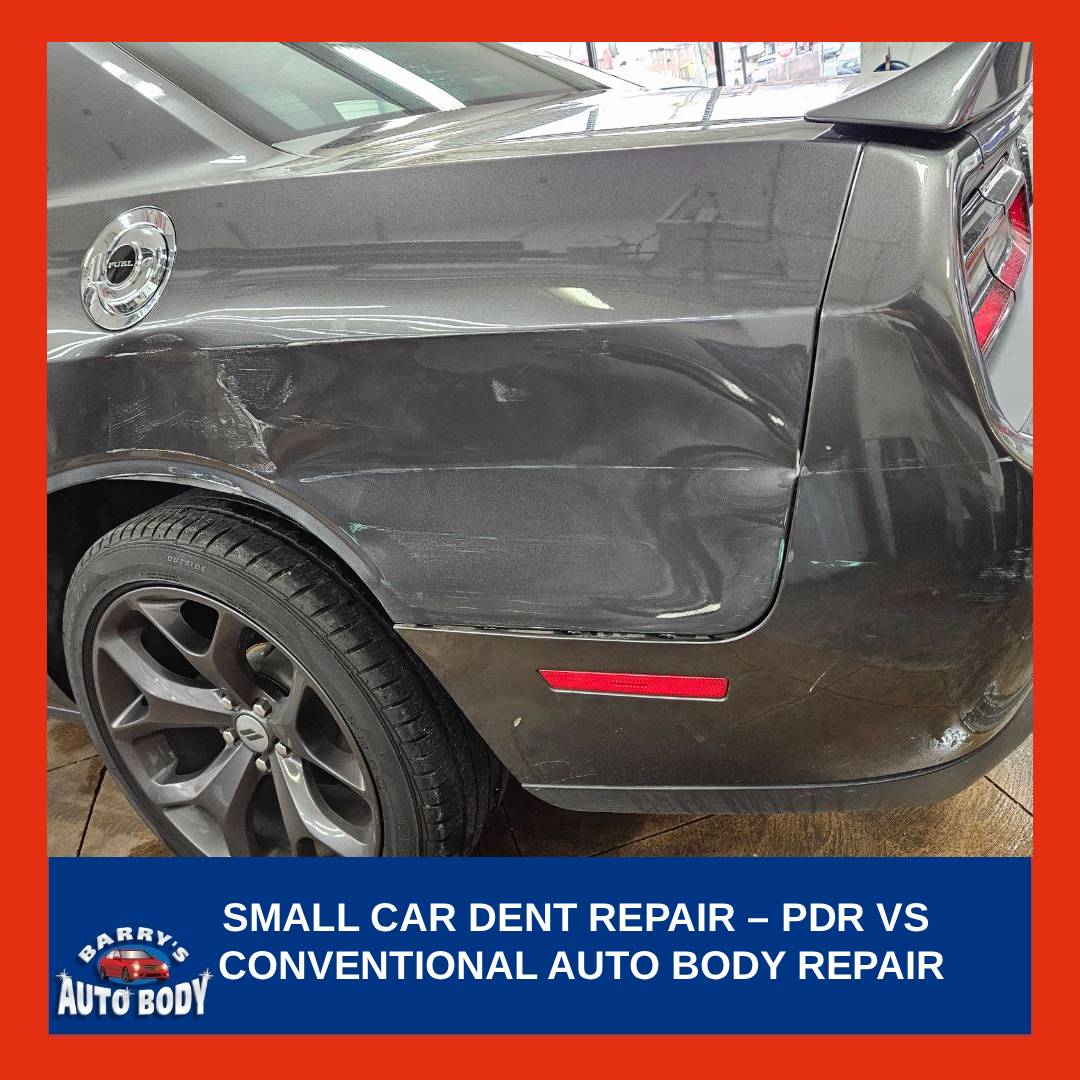
A small dent can be frustrating because it raises a surprisingly difficult question: how much repair does it actually need?
Some dents may be suitable for paintless dent repair, often called PDR. Others may need conventional body repair, refinishing, or even panel replacement. The size of the dent alone does not determine the answer.
A shallow dent in the middle of a panel may sometimes be easier to repair than a smaller dent located on a sharp body line, near the edge of a panel, or in an area with damaged paint. Previous repairs, panel material, access behind the dent, and possible hidden collision damage can also affect the repair method.
The FAQs below explain how technicians may evaluate small dents and what vehicle owners should know before deciding how to repair them.
1. Do All Small Dents Need Traditional Auto Body Repair?
No. Some small dents may be suitable for paintless dent repair, which can reshape the metal without sanding, body filler, primer, or repainting.
However, PDR is not appropriate for every dent.
A technician may consider:
- Whether the paint is still intact
- How deep the dent is
- Where the dent is located
- Whether the metal has been stretched
- Whether the panel can be accessed from behind
- Whether previous repairs are present
- What material the panel is made from
This is why two dents that look nearly identical from a distance can require very different repair methods.
2. What Exactly Is Paintless Dent Repair?
Paintless dent repair is a technique used to reshape certain dents while preserving the existing paint finish.
Depending on the location of the dent, technicians may use specialized tools behind the panel to gradually massage the metal back toward its original contour. In other cases, controlled pulling techniques may be used from the exterior.
PDR generally works best when:
- The factory paint remains intact
- The dent is relatively shallow
- The panel has not been severely stretched
- The damaged area can be accessed effectively
- The dent is not located in an unsuitable structural area
One of the main advantages is that the original finish may be preserved. That can reduce the amount of material and refinishing required.
3. How Can I Tell If the Paint Has Been Damaged?
Look closely at the dent under good lighting.
Possible signs of paint damage include:
- Cracking
- Chipping
- Flaking
- Scratches that expose primer or metal
- Fine stress lines around the dent
- Paint appearing stretched or fractured
The tricky part is that paint damage is not always obvious.
Modern automotive finishes can sometimes flex during an impact and appear intact at first. In other cases, very small cracks may only become visible under bright inspection lighting.
If the paint has been broken, conventional repair and refinishing may be more appropriate than PDR.
When repainting becomes necessary, achieving a consistent finish involves more than simply finding the factory color code.
4. Does the Size of the Dent Determine Whether PDR Will Work?
Not necessarily.
Size matters, but it is only one factor.
A larger, shallow dent in an open section of a door might sometimes be easier to repair than a small but sharp dent located directly on a body line.
Technicians often pay close attention to:
- Dent depth
- Sharpness
- Metal stretching
- Location
- Panel shape
- Access behind the panel
This is an important point for customers because a small dent is not automatically a simple repair.
5. Why Are Dents on Body Lines More Difficult?
Body lines are the creases and contours designed into vehicle panels.
They help define the shape and appearance of the vehicle, but they also create areas where the metal may be more rigid.
If a dent sits directly on a body line, the repair may require greater precision. The metal has to be returned not only to a smooth surface but also to the correct contour.
Some body-line dents may still be suitable for PDR, while others may require conventional repair depending on their depth, position, and the condition of the metal and paint.
6. Does the Location of the Dent Matter?
Yes. Location can have a major influence on the repair method.
A dent in the center of a large panel may be easier to access than one near:
- A panel edge
- A wheel arch
- A door frame
- A reinforcement section
- A sharp crease
- A structural mounting point
Some areas have multiple layers of metal behind them. Others may contain wiring, sound insulation, intrusion beams, sensors, or brackets.
If a technician cannot safely reach the back of the dent, the repair approach may need to change.
7. Can a Small Dent Hide Damage Underneath the Panel?
It can.
Many small dents are primarily cosmetic, but an impact can sometimes affect components behind the visible surface.
This may be more relevant when the dent occurred near:
- A bumper
- A wheel arch
- A door edge
- A light assembly
- A sensor location
- A structural mounting area
Possible hidden concerns might include:
- Broken clips
- Damaged brackets
- Cracked absorbers
- Loose wiring
- Shifted sensors
- Minor movement of mounting components
This does not mean every dent hides deeper damage. It simply means the visible dent may not always tell the entire story.
If the dent followed a collision, our guide on how hidden damage is found after a minor accident explains how disassembly, diagnostic scans, alignment measurements, and other inspections may reveal damage that cannot be seen initially.
8. Can a Dent Be Repaired If the Metal Has Stretched?
Possibly, but stretched metal can make the repair more difficult.
When metal is pushed beyond a certain point, it may not return easily to its original shape.
Signs of stretching can include:
- A very deep dent
- A sharply pointed impact area
- Rippling around the dent
- Metal that appears loose or unstable
In these situations, conventional repair may provide better control over the final contour.
A technician may use bodywork techniques, filler where appropriate, sanding, priming, and refinishing depending on the condition of the panel.
9. What If the Panel Has Been Repaired Before?
Previous repairs can affect the available repair options.
For example, a panel may already contain:
- Body filler
- Refinished paint
- Previous dent repairs
- Repaired corrosion
- Replacement sections
PDR techniques may place controlled pressure on the panel from behind.
If body filler or previously repaired material is present, that pressure could potentially crack or disturb the older repair.
This is one reason technicians may inspect the area carefully before deciding whether PDR is suitable.
10. Does the Panel Material Make a Difference?
Yes.
Many vehicle body panels are made from steel, but modern vehicles may also use:
- Aluminum
- High-strength steel
- Composite materials
- Plastic panels
Different materials behave differently when damaged.
Aluminum, for example, can require different techniques from traditional steel because it responds differently to pressure, stretching, and heat.
The repair method may therefore depend not only on what the dent looks like, but also on what the panel is made from.
11. When Might Conventional Auto Body Repair Be Required?
Traditional repair may be more appropriate when:
- The paint is cracked or chipped
- The metal is heavily stretched
- The dent is very sharp
- The panel edge is damaged
- There is severe creasing
- The area has previous repairs
- Access for PDR is limited
- Hidden damage is discovered
A conventional repair might include:
- Reshaping the damaged panel
- Applying filler where appropriate
- Sanding and refining the surface
- Applying primer
- Color matching
- Refinishing the panel
- Blending adjacent areas when necessary
The exact process can vary depending on the vehicle, panel material, paint system, and extent of the damage.
12. Will Traditional Repair Always Mean Repainting the Whole Car Panel?
Not necessarily, although refinishing may be required when the paint itself has been damaged.
Depending on the location, color, and type of finish, technicians may refinish the repaired area or panel and sometimes blend into an adjacent area to create a more consistent appearance.
Metallic and pearl finishes can be particularly sensitive to application technique and viewing angle.
This is why professional paint matching involves much more than simply looking up a factory color code.
13. Is It Better to Repair a Small Dent Quickly?
In many cases, addressing a dent earlier can be useful.
If the paint remains intact, the dent may remain primarily cosmetic.
If the paint is chipped and bare metal is exposed, however, moisture could eventually contribute to corrosion.
A dent may also interfere with:
- Door operation
- Trim fit
- Sensor positioning
- Panel alignment
There is not always an emergency, but an earlier inspection can help clarify whether the issue is purely cosmetic or something that might deserve additional attention.
14. Can I Repair a Small Dent Myself?
Some DIY kits are designed for simple dent pulling, but results can vary considerably.
The main risk is making the panel more difficult to repair afterward.
Potential DIY problems can include:
- Pulling the metal too far
- Creating high spots
- Cracking the paint
- Damaging trim
- Distorting body lines
- Making the damaged area larger
A dent that appears simple may behave differently once pressure is applied.
If preserving the existing finish is important, having the dent professionally assessed before attempting a repair may be a good option.
15. Will Paintless Dent Repair Preserve My Factory Paint?
When PDR is appropriate and performed successfully, one of its main advantages is that the existing paint finish can remain in place.
That means there may be no need for:
- Sanding
- Primer
- Repainting
- Color blending
Preserving the factory finish can be particularly appealing on newer vehicles.
However, PDR cannot restore paint that has already cracked, chipped, or separated from the panel.
16. Is Paintless Dent Repair Always Cheaper Than Conventional Repair?
It can be, but not always.
Cost can depend on:
- Dent size
- Location
- Number of dents
- Access difficulty
- Panel material
- Required trim removal
- Vehicle design
A particularly difficult PDR repair may require substantial labor.
A technician should ideally assess the actual dent before determining which approach may be more practical.
17. Can Insurance Cover a Small Dent?
It may.
Coverage can depend on the cause of the damage, the insurance policy, the deductible, and the circumstances of the incident.
For example, dent damage could result from:
- Another vehicle
- Hail
- Falling objects
- Parking lot impacts
- Storm damage
Whether making a claim makes financial sense can depend on the expected repair cost relative to the deductible and other policy considerations.
Vehicle owners may want to check directly with their insurer rather than assuming a particular repair will either be covered or excluded.
18. How Does a Technician Decide Between PDR and Conventional Repair?
A proper assessment is usually based on several factors rather than one visual clue.
The technician may evaluate:
- Paint condition
- Dent depth
- Dent diameter
- Location
- Panel access
- Panel material
- Body lines
- Metal stretching
- Previous repairs
- Possible hidden damage
The objective is to choose a repair method appropriate for the actual condition of the panel while avoiding unnecessary work.
That might mean paintless dent repair.
It might mean conventional auto body repair.
In some circumstances, panel replacement may be the more appropriate option.
19. What Questions Should I Ask Before Approving a Dent Repair?
You do not need to understand every technical detail of collision repair. A few targeted questions can help you understand why a particular method is being recommended.
Is my paint still intact?
This can help determine whether PDR may be possible.
Can this dent be accessed properly?
Accessibility can significantly affect the repair method.
Is the dent only cosmetic?
This helps clarify whether anything behind the panel may also need inspection.
Why are you recommending PDR or conventional repair?
The explanation should relate directly to the condition and location of your vehicle’s damage.
Will any trim or components need to be removed?
This can help you understand the actual scope of the repair rather than judging the work only by the size of the dent.
These questions can provide much more useful information than simply asking how much it will cost to remove the dent.
20. When Should Barry’s Auto Body Inspect the Dent?
If you are unsure whether a dent requires traditional body repair, Barry’s Auto Body can inspect the affected panel and help determine which repair approach may be appropriate.
The assessment may consider:
- Paint condition
- Dent shape and depth
- Panel material
- Access behind the damage
- Previous repairs
- Nearby components
- Possible hidden damage
Where suitable, paintless dent repair may provide a way to restore the panel while retaining the existing finish.
Where the damage is more complex, conventional auto body repair may provide a more appropriate solution.
The important point is not to assume that every small dent requires extensive bodywork—or that every small dent can be repaired with a quick pull.
So, Do Small Dents Always Require Full Auto Body Repair?
No. The size of the dent is only one part of the diagnosis.
Some small dents may be suitable for paintless dent repair, while others may need conventional bodywork, paint refinishing, or a more detailed inspection.
A small but sharp dent on a body line could be more complicated than a larger shallow dent in the middle of a door. Paint condition, metal stretching, panel construction, previous repairs, accessibility, and the location of the impact can all influence the repair approach.
If the dent resulted from even a relatively small collision, it can also be useful to understand what types of hidden damage may occur after a minor accident rather than judging the vehicle solely by what can be seen from the outside.
If your vehicle has picked up a dent, an inspection can help establish what actually needs to be repaired before you commit to a particular method.