

Frequently Asked Questions About Auto Body Paint Matching
Getting your vehicle back from an auto body shop can be exciting, but it can also raise questions. One of the most common concerns drivers have is whether the newly repaired panel matches the rest of the vehicle.
Sometimes the paint appears identical. Other times, it may seem slightly lighter, darker, glossier, or different depending on where you’re standing or how the light hits it.
In many cases, these differences have perfectly reasonable explanations. In others, they may indicate that additional adjustments are needed.
This FAQ answers the most common questions about automotive paint matching so you can better understand what to expect after a repair.
1. Why Doesn’t My New Paint Look Exactly Like the Rest of My Car?
Even when the correct factory paint code is used, a perfect match isn’t always as simple as mixing one color.
Modern automotive paint is influenced by several factors, including:
- Vehicle age
- Sun exposure
- Weather conditions
- Previous repairs
- Manufacturing variations
- Paint application technique
Your original paint may have gradually faded over several years, while the newly painted panel is fresh. That difference can sometimes make the repair appear slightly different at first.
Professional paint matching aims to make the repair blend naturally with the surrounding panels rather than simply applying the factory formula.
2. Doesn’t Every Car Have a Factory Paint Code?
Yes.
Most vehicles include a manufacturer’s paint code, typically found inside the driver’s door jamb, under the hood, or in the owner’s documentation.
However, the paint code is only the starting point.
Why?
The same paint code may have multiple manufacturer-approved variations because paint batches can differ slightly during production.
Professional paint suppliers often provide several approved “variants” of the same color, allowing technicians to select the closest match.
3. Why Does My Paint Look Different in Sunlight Than Indoors?
This is one of the most common questions after a repair.
Automotive paint behaves differently under different lighting conditions.
For example:
- Direct sunlight
- Shade
- LED workshop lights
- Fluorescent lighting
- Cloudy weather
- Night-time street lighting
Metallic and pearl finishes are especially sensitive to lighting because they reflect light differently depending on the viewing angle.
This phenomenon is completely normal and is often referred to as flop or color travel.
4. What Is Paint Blending?
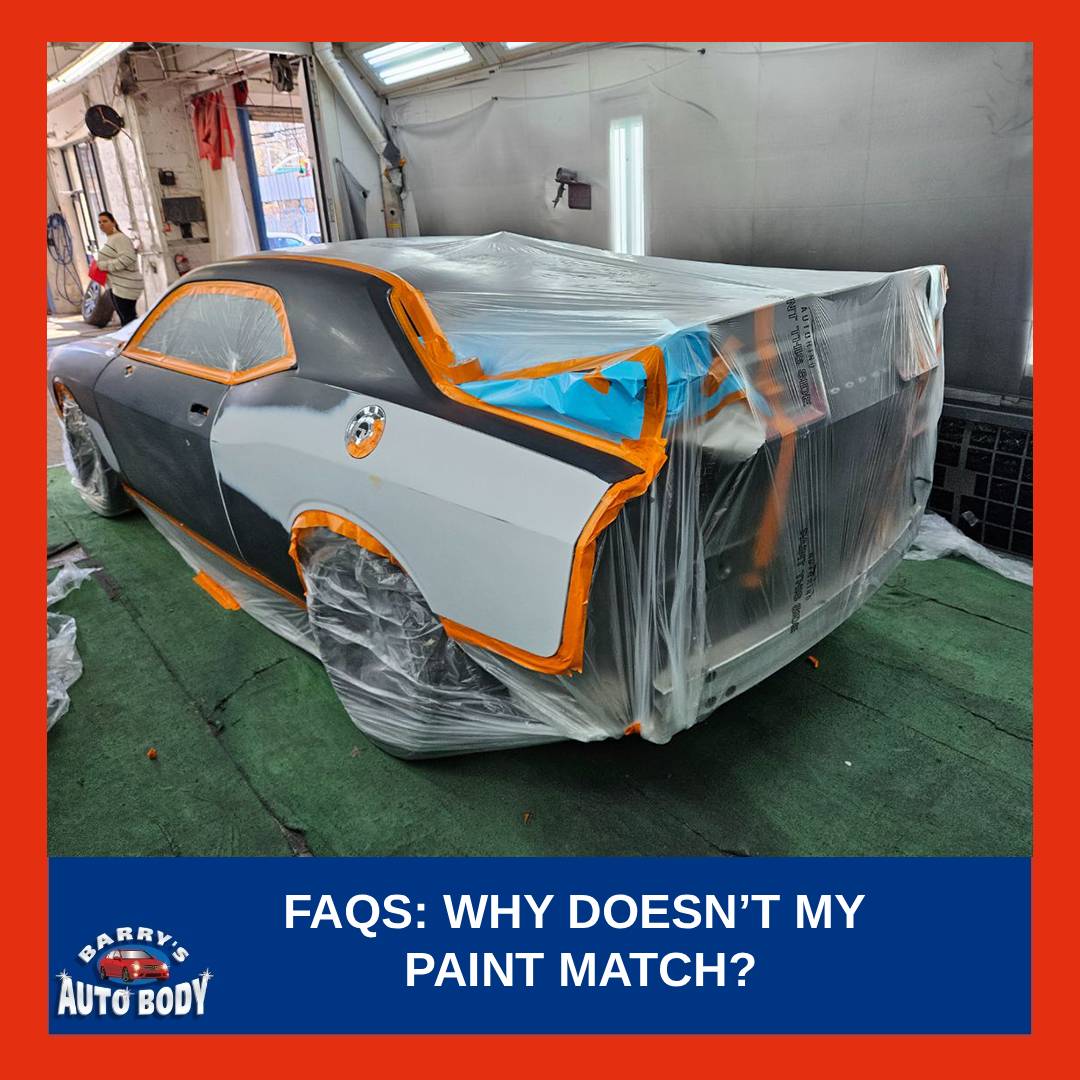
Paint blending is a professional technique used to make repaired panels transition smoothly into the surrounding panels.
Instead of painting only the damaged panel, technicians may gradually blend color into the adjacent panel.
For example:
Instead of painting only a repaired front fender, the color might also be lightly blended into the front door.
This reduces the chance of noticeable color differences where panels meet.
Blending is widely considered one of the most effective methods for achieving a natural-looking repair.
5. Why Would a Body Shop Paint Panels That Weren’t Damaged?
Many vehicle owners are surprised to discover that an adjacent panel was also painted.
In many situations, this is intentional.
It often helps create a smoother visual transition between the repaired area and the original finish.
Rather than being unnecessary work, blending can improve the overall appearance of the repair.
6. Can Older Paint Be Matched Perfectly?
It depends.
As paint ages, it can change because of:
- UV exposure
- Oxidation
- Weather
- Regular washing
- Environmental contaminants
Professional color matching can usually achieve an extremely close match, but expecting a mathematically perfect match on older paint may not always be realistic.
The goal is often to make the repair visually seamless under normal viewing conditions.
7. Why Does the Repaired Panel Look Shinier Than the Rest of My Car?
A freshly painted panel often receives:
- New clear coat
- Fresh polishing
- Modern finishing techniques
If the surrounding panels have several years of wear, they may naturally appear less glossy.
Sometimes the difference becomes less noticeable after the paint fully cures and the vehicle receives routine detailing.
8. Will the Paint Change as It Cures?
Yes, it can.
Fresh automotive paint continues curing after it leaves the spray booth.
During this period, slight changes in:
- Gloss
- Hardness
- Appearance
may occur.
While dramatic color changes shouldn’t happen, minor visual changes during curing can be normal.
9. Does Metallic Paint Make Matching More Difficult?
Generally, yes.
Metallic paints contain tiny aluminum flakes.
The direction in which these flakes settle during spraying can affect how light reflects off the surface.
Two panels using identical paint can appear slightly different if the metallic particles are oriented differently.
Professional spray technique plays a significant role in minimizing these differences.
10. What About Pearl or Tri-Coat Paint?
Pearl and tri-coat finishes are among the most challenging automotive colors to match.
These systems often include:
- Base color
- Pearl mid-coat
- Clear coat
Even small variations in application can influence the final appearance.
Because of this complexity, blending neighboring panels is often considered a good option.
11. Can Machine Polishing Fix a Color Difference?
Not always.
Machine polishing can improve:
- Gloss
- Surface clarity
- Minor imperfections
However, polishing generally cannot change the paint color itself.
If the issue relates to color rather than finish, another solution may be needed.
12. How Do Professional Body Shops Match Paint?
Professional shops typically combine several techniques rather than relying only on the paint code.
These may include:
- Manufacturer’s paint formulas
- Paint variant selection
- Digital color scanning
- Spray-out test cards
- Visual comparison under multiple lighting conditions
- Paint blending techniques
Using multiple methods helps produce a closer overall match.
13. What Should I Do If I Think My Paint Doesn’t Match?
Before assuming something is wrong, consider viewing the vehicle:
- In direct sunlight
- In the shade
- From different angles
- On a clean surface
If the difference still appears obvious, it’s a good idea to contact the repair facility.
A reputable body shop will usually inspect the repair, explain the results, and discuss whether any adjustments may be appropriate.
14. Can a Properly Repaired Car Look Like It Was Never Damaged?
In many cases, yes.
Modern repair methods, professional paint systems, and proper blending techniques can often produce excellent cosmetic results.
The final outcome depends on factors such as:
- Vehicle age
- Paint condition before repair
- Color complexity
- Repair quality
- Preparation and finishing
While every repair is unique, the goal is generally to restore the vehicle so that the repair is difficult to notice during everyday use.
Key Takeaways
If you’re wondering why a repaired panel looks slightly different, remember these important points:
- A factory paint code is only the starting point.
- Lighting can dramatically change how paint appears.
- Older paint naturally fades over time.
- Metallic and pearl finishes are more difficult to match.
- Paint blending often produces the most natural-looking repairs.
- Professional preparation and application make a significant difference.
A slight difference under certain lighting conditions doesn’t necessarily indicate poor workmanship. Modern automotive paint matching is a highly specialized process that balances science, technology, and craftsmanship to achieve the closest possible result.
If you have questions about a recent repair or would like advice on paint matching, the team at Barry’s Auto Body can inspect your vehicle, explain what you’re seeing, and recommend the most appropriate next steps based on your vehicle’s condition.